
Trash to Treasure: Applying Circular Architecture at Bonavista Bridge
> » Blog » Trash to Treasure: Applying Circular Architecture at Bonavista Bridge
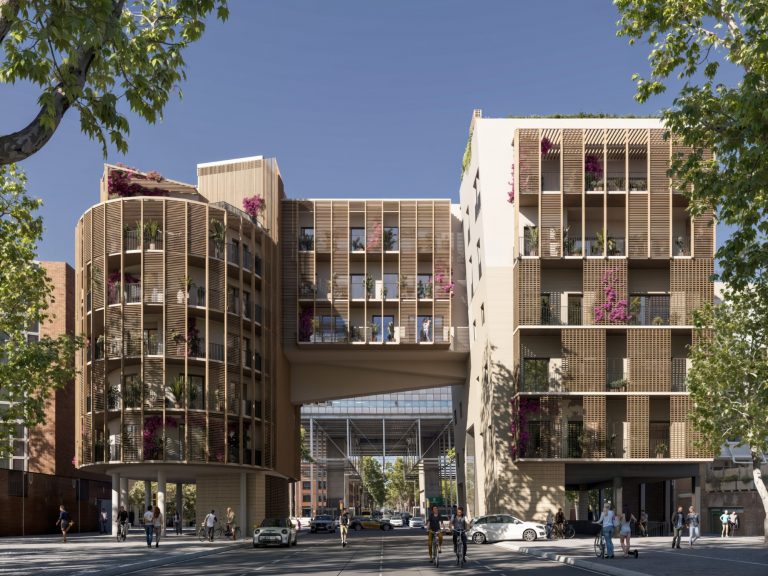
Rehabbing a building isn’t just about updating its spaces, it’s also about responsibly managing the materials already there.
With Batlleiroig, the architecture firm responsible for the project, we’ve implemented a strategy akin to urban mining at Bonavista Bridge (Av. Icaria), showing how one site’s trash can become another site’s treasure, a basic principle of circular construction on large-scale projects.
This practice is based on recycling components and reintroducing them into the urban fabric, an approach that completely transforms the traditional building lifecycle. With this practice, we prevent overexploitation of new natural resources and reduce the environmental impact of our interventions starting at the demolition phase.
1. Selective demolition: salvaging original granite
The way we worked on the original facade at Bonavista Bridge allowed us to recover 15,600 ft² of granite cladding.
Thanks to selective demolition, we prevented this granite from turning into demolition waste, something common in a conventional process, foregoing the opportunity to utilize recyclable material with high construction and environmental value.
However, under the circularity criteria defined with Batlleiroig, these components were treated as a valuable urban resource reserve, ready to be reintroduced in the construction cycle. The goal is to facilitate direct reutilization of these materials in new environments and demonstrate that sustainable architecture also involves building on and making the most of what has already been built.
The preservation of these natural stone blocks not only prevents strain on local landfills, but also reduces the need to open new mining fronts in distant quarries. By treating the city’s very fabric as a source of usable resources, we cut down supply chains and guarantee that the historical value of original materials stays alive within the region’s manufacturing economy.
Immediate impact on the Roques Blanques cemetery
The effectiveness of this strategy is now a tangible reality. A total of 3,230 ft² of granite recovered from the Vila Olímpica project has already been reused in its entirety to pave the Roques Blanques cemetery.
This movement has allowed us to provide a second life to 16 tons of stone, transforming them into secondary raw materials. This foregoes the environmental toll of traditional extractive processes, specifically preventing the extraction of 65 ft2 of quarry stone.
This also demonstrates the viability of controlled circular material flows. Instead of processing new industrial flooring requiring large amounts of water and energy, the direct transfer of this granite ensures a structured integration into new urban infrastructure.
- Impact indicators: drastic emissions reduction
Direct reuse of high-density materials, such as granite, provides immediate environmental benefit which can be audited and measured in terms of carbon footprint:
- Conservation of natural resources: new stone isn’t extracted from quarries and synthetic flooring materials are not manufactured.
- 93% reduction in emissions: since the extraction, industrial cutting and new material processing processes are eliminated entirely, the greenhouse gas emissions associated with the facade drop drastically.
- Carbon footprint mitigation: the reduced emissions in turn, is equivalent to an estimated 4.3 ton decrease in CO₂.
These indicators demonstrate the impact that technical decisions based on material conservation can have on the construction industry.
Each material diverted from conventional waste streams directly reduces the environmental impact from heavy-duty transportation and notably optimizes our residential developments’ global ecology audits.
3. A new way of understanding renovating historical heritage assets
The remaining the granite and brick removed from Bonavista Bridge has been stored and categorized in inventory for future application in upcoming BiR projects.
This method completely shifts the construction paradigm and drives the circular economy at full scale. Buildings are no longer designed as static, isolated structures where the process ends when construction does, they actually lead to the next project. The waste from any project site serves as a material bank holding resources ready for use in future projects.
The energy commitment of the building is also bolstered by this, with photovoltaic solar energy intended for common areas. This guarantees high energy efficiency overall in the building’s common services, reducing dependency on external sources and continuously reducing the property’s operational carbon footprint.
The new roadmap: following circular architecture’s footsteps
With this intervention on Bonavista Bridge, BiR and Bonavista Developments are consolidating their commitment to impeccable technical execution. The representativeness and contemporary design of our homes live together in perfect harmony with responsible engineering which protects, conserves, and optimizes the planet’s natural resources.
This integrated building model is becoming the essential roadmap to more balanced and environmentally-conscientious urban project development. Every structural and institutional decision made in the present helps safeguard the city’s environmental stability, ensuring that residential growth and historical heritage conservation take great strides toward the sustainability standards of the future.